
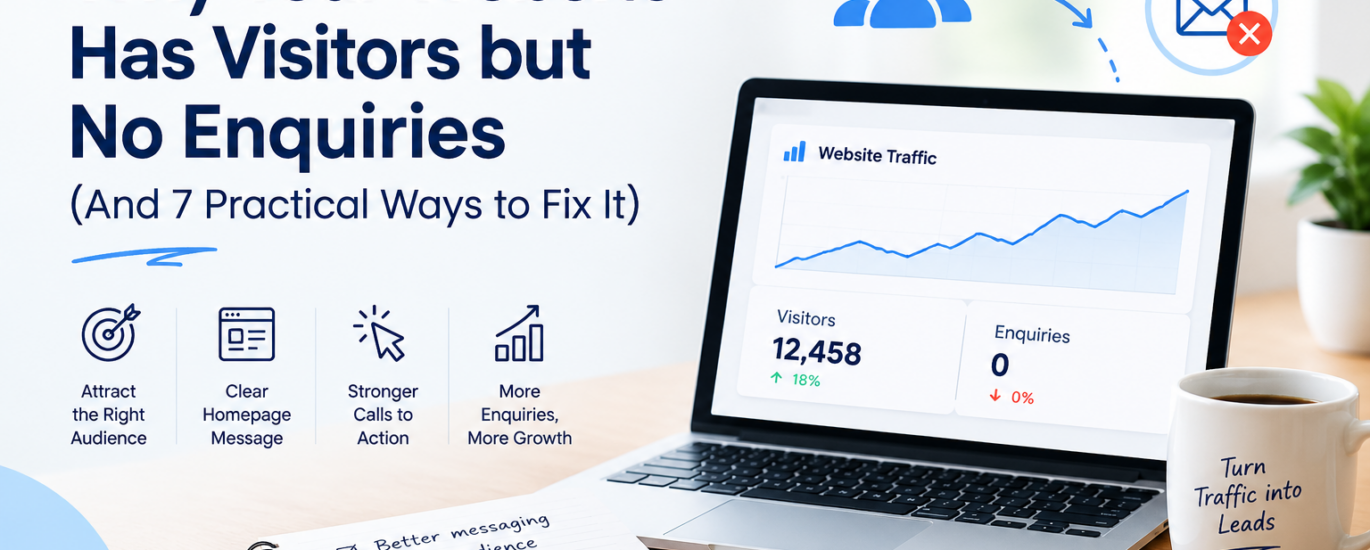
A website that gets traffic but no leads has a conversion problem, not a traffic problem. The usual causes are visitors who were never ready to buy, a value proposition that is hard to understand, weak trust signals, and a contact process that feels like too much effort. Sending more visitors to a site that cannot convert them only gives you bigger numbers on a dashboard, not more enquiries, calls or sales.
This guide walks through the most common reasons a website attracts visitors without generating leads, and gives you a practical fix for each one. Whether your traffic comes from SEO, Google Ads, social media or all three, and whether you manage the site yourself or work with a digital marketing agency in Chennai, you will be able to find where your leads are leaking.
The Traffic-Without-Leads Problem Is More Common Than You Think
Most businesses meet this problem sooner or later. Google Analytics shows sessions climbing, Search Console shows more impressions, rankings improve, and yet the phone stays quiet. The contact form gets a handful of messages a month, and half of them are spam.
The gap is easy to explain. Widely cited industry benchmarks, such as WordStream’s conversion rate studies, put the average website conversion rate at roughly 2 to 3 percent. That means around 97 out of every 100 visitors leave without doing anything. Even a small improvement in that rate can produce far more leads than a large increase in traffic.
The problem persists because traffic and conversion are often handled separately. One team or vendor works on SEO and ads to bring people in. Another team builds and maintains the website. Nobody owns the space in between, and that is where leads disappear. At Seven Horses, a full stack digital agency in Velachery, Chennai, we treat the two as one system: the visitor, the page and the next step.
Diagnosis First: The 7 Root Causes of Traffic Without Leads
Before you change anything, work out which problem is hurting you most. Applying the wrong fix wastes time and budget.
Root Cause 1: You Are Attracting the Wrong Traffic
Some traffic was never going to convert. It comes from keywords, channels or locations that do not match the people who buy from you.
Ask yourself these questions:
- Which pages bring in the most visitors? Are they service pages that buyers land on, or blog posts that mostly attract students and researchers?
- Which search queries bring people to your site? Are they commercial queries such as “best digital marketing agency in Chennai” or “SEO services in Chennai”, or purely informational ones such as “what is SEO”?
- Where do your visitors live? If you serve Chennai businesses but most of your visitors are from other countries, they will not become customers however good the page is.
- Which devices do they use? A large share of mobile visitors on a site that is not mobile friendly will always convert poorly.
Think about intent in layers. People who search for your brand name already know you and should convert at the highest rate. People who search for “hire” or “best” plus your service are comparing options and are ready to act. People who search for “how to” or “what is” are learning, and they will convert far less often. Visitors who arrive from casual social media browsing are the least likely of all to enquire.
If most of your traffic falls into the learning group, your overall conversion rate will look poor even when your pages are working well for the buyers in the mix.
The fix: Segment your analytics. Measure conversion separately for branded, commercial and informational traffic. If high-intent visitors are not converting, the problem is on the page. If only informational visitors are not converting, you need more commercial-intent traffic through targeted SEO and a nurture plan, such as email or retargeting, for the researchers.
Root Cause 2: Your Value Proposition Is Not Clear
When someone lands on your website, the first few seconds are spent answering one question: am I in the right place? If they cannot tell what you do, who you do it for and why you are different, they go back to Google and click the next result.
A simple test: Show your homepage to five people who have never seen it, for five seconds only. Then ask what the company does, who it is for, and why they would choose it. If fewer than four people can answer all three, your value proposition is your main conversion problem.
A clear message above the fold covers four things:
- What you do, in specific words rather than vague ones
- Who it is for, named plainly
- The result the customer gets, not just the service you deliver
- One reason to choose you over the alternatives
Compare these two versions. The weak one says: “We are a digital marketing agency offering comprehensive solutions for your business.” The stronger one says: “We help Chennai businesses get found on Google and turn that traffic into enquiries, with monthly reports you can actually read.” The second version passes the five-second test. The first could describe almost any agency in the city.
Root Cause 3: Your Calls to Action Are Weak or Hidden
A call to action (CTA) is where a visitor’s interest becomes a measurable step. When the CTA says only “Contact Us” or “Learn More”, is hard to see, or is missing from key pages, interested visitors do not know what to do next and the moment passes.
Review your CTAs with these points in mind:
- Is there a visible CTA on the homepage without scrolling?
- Does the button stand out from the surrounding design?
- Does the text describe what the visitor receives, such as “Get My Free Website Audit”, rather than what they must do, such as “Submit”?
- Do long pages repeat the CTA after the testimonials, after the FAQ and near the footer?
- Does every service page have a CTA that fits that service?
- Do blog posts end with a CTA related to the topic?
Good CTA copy usually follows one of a few patterns. An outcome-led CTA promises a result, such as “Get a Free SEO Audit”. A low-risk CTA removes fear, such as “Book a Free Call, No Obligation”. A specific CTA sets expectations, such as “Get Your 30-Minute Strategy Session”. Pick the pattern that suits the page and test it.
Root Cause 4: Your Landing Pages Do Not Match the Traffic Source
This is the message match problem, and it quietly wastes a lot of ad spend. Imagine someone clicks a Google Ad promising a free SEO audit for Chennai businesses, then lands on a generic services page. The promise and the page do not line up, so they leave.
The same idea applies to organic traffic. A blog post that ranks for “how to reduce cost per lead in Google Ads” and ends without any related offer has missed a chance to turn relevant attention into an enquiry.
To check your message match:
- Open your top paid ads in one set of tabs and their landing pages in another.
- Read the ad, then read the landing page headline.
- Ask whether the page feels like a direct answer to the ad’s promise.
- Fix any page where the offer, wording or call to action differs from the ad.
For paid campaigns, a dedicated landing page for each campaign almost always beats sending traffic to the homepage. If you run Google Ads or other search campaigns, build the page and the ad together.
Root Cause 5: Your Social Proof Is Missing or Unconvincing
People rarely hand their details to a business they do not trust. For service businesses and agencies, social proof is the main way a stranger decides whether you are safe to contact. Most buyers read reviews before making a decision, so a site with no proof asks visitors to take a leap of faith.
There are two common mistakes. The first is having no social proof at all: no testimonials, case studies, client logos or review badges. The second is having generic proof, such as an anonymous “Great service, highly recommend!”. Vague praise looks like a placeholder, and visitors have learned to ignore it.
Strong social proof is specific. In rough order of strength:
- Video testimonials from real clients, which are hard to fake and build trust quickly
- Case studies with real numbers, such as how traffic or enquiries changed over a stated period
- Named testimonials that describe the starting problem, what was done and the result
- Recognisable client logos, which borrow credibility from brands visitors already know
- Google reviews and other third-party ratings that you do not control
Weak proof, such as unattributed quotes and unverifiable claims like “award-winning”, can actually lower trust.
A simple formula for a testimonial: the situation before, what the agency did, the measurable result, the timeframe, and the client’s full name, role and company.
Root Cause 6: Your Forms Are Too Long or Badly Designed
Every extra form field gives a visitor another reason to quit. Marketing research from platforms such as HubSpot has repeatedly shown that shorter forms usually bring more submissions. Ask only for what you need to start a conversation.
A good starting point by type of form:
- Consultation request: name and phone number or email
- Free audit: name, email and website address
- Free guide or download: email only
- Quote request: name, email and a short description of the project
Avoid these common form mistakes:
- Required fields that only matter after the sale, such as budget, team size or company turnover. Ask these on the first call instead.
- Buttons that say only “Submit” or “Send”. Use benefit-led text such as “Get My Free Audit”.
- No reassurance near the form. Add a privacy note and a promise about response time, such as “We reply within one working day”.
- Forms that are hard to use on a phone. If people have to zoom or scroll sideways, you lose them.
- No quick alternative. Many Indian customers prefer WhatsApp or a phone call, so add a click-to-call button and a WhatsApp link beside the form.
Root Cause 7: Your Website Is Too Slow
A visitor who leaves before your page finishes loading never sees your offer. Analytics will count them as a bounce, not as a lost lead, so the damage stays hidden.
Google’s own research, often quoted in industry studies, found that more than half of mobile visitors leave a page that takes longer than three seconds to load. Speed also feeds into SEO through Core Web Vitals, so a slow site hurts both your rankings and your conversions.
Run your top five pages through Google PageSpeed Insights. If the Largest Contentful Paint is above four seconds on mobile, your page speed is costing you leads. Common fixes include compressing images, using modern image formats, reducing heavy scripts, enabling caching and choosing better hosting. For a detailed walkthrough, read our guide on 10 ways to improve website speed for better SEO rankings.
The Traffic-to-Leads Audit: A Step-by-Step Process
Rather than guessing, run this audit. It takes a few hours and shows you where to focus.
Step 1: Segment Your Traffic Quality
In Google Analytics 4, open the traffic acquisition report and look at sessions by source and medium alongside key events or conversions. Mark the sources that convert above 1 percent and those that fall below half a percent. Low-converting sources point to the wrong audience, the wrong landing page, or both.
Step 2: Run the Five-Second Homepage Test
Show your homepage to five outsiders for five seconds and ask the three questions from Root Cause 2. Score yourself out of five. A score below four means your message needs rewriting before anything else.
Step 3: Map CTAs to Your Top Pages
List your twenty most visited pages in a spreadsheet. For each one, note whether a CTA exists, whether it sits above the fold, whether the wording promises an outcome and whether it stands out visually. Pages without a strong CTA are lost opportunities.
Step 4: Check Message Match
For every active campaign, compare the ad to the landing page. The headline, the offer and the call to action should all echo what the ad promised. Any mismatch is costing you enquiries.
Step 5: Audit Your Social Proof
On each key service page, look for at least one specific testimonial with a result, one third-party rating and one named client or logo. Pages with no proof rarely convert to their potential.
Step 6: Audit Every Form
Count the required fields, remove those that are not needed for the first conversation, rewrite the button text, and test the form yourself on a phone.
Which Fixes to Do First
Not every fix delivers the same return. Use this order as a guide.
Start with the biggest-impact work: rewrite your above-the-fold value proposition, because everything else depends on visitors understanding what you offer. Next, fix message match between ads and landing pages if you run paid campaigns, and add specific social proof to your main service pages. These take more effort but move the numbers most.
Then pick up the quick wins that take hours rather than weeks: cut unnecessary form fields, rewrite CTA copy, move CTAs above the fold, and add trust signals such as response-time promises and a privacy note near forms.
Finally, take on the technical and strategic work: improve page speed, optimise forms for mobile, and refine your traffic mix toward commercial-intent keywords through content marketing and local SEO.
How Seven Horses Finds and Fixes the Traffic-Without-Leads Problem
At Seven Horses Software Solutions, a full stack digital marketing agency in Velachery, Chennai, this is one of the most common briefs we receive. Businesses have usually invested in SEO, ads or social media, traffic has grown, and enquiries have not. In most cases several of the causes above are working together.
Our approach follows the same six steps we use for every client, from consultation to reporting:
- Consultation and research. We start by understanding your goals, your customers and what counts as a lead for your business. We review your analytics, your top pages, your keywords and your audience.
- Fixing the quick wins. We improve CTAs, shorten forms, add trust signals and tighten the first screen of your key pages, so you see early movement.
- Landing pages and message match. We build focused landing pages for campaigns and add relevant CTAs to your highest-traffic blog posts and service pages. Our UI/UX design and website development teams handle the layout, speed and mobile experience.
- Review and reporting. We track leads against traffic every month, so you see conversion rate improving, and each round of changes informs the next.
Because SEO, ads, content, design and development sit under one roof, nothing falls into the gap between traffic and conversion.
Preventing the Problem: Build Conversion Into Your Strategy From Day One
The businesses that avoid this problem build conversion in before they scale traffic, not after.
- Define your conversion goals first. Before any SEO or ad campaign goes live, decide what counts as a conversion, whether that is a form fill, a call or a WhatsApp message, and set it up as a key event in Google Analytics 4.
- Build dedicated landing pages. Avoid sending campaign traffic to the homepage. Give each campaign a page built for it.
- Set up basic trust signals early. Have at least one specific testimonial, a visible phone number in the header and a response-time promise near your form before you start driving visitors.
- Fix conversion before scaling spend. If your current traffic converts at a very low rate, adding more paid traffic to the same pages only multiplies the waste.
- Review conversion rate monthly. Look at conversion rate by source, not just total visits. A sudden drop in one source usually signals a traffic quality or page problem you can fix quickly.
Frequently Asked Questions About Website Traffic but No Leads
Why does my website get traffic but no enquiries?
The most common reasons are traffic that does not match your buyers, an unclear message above the fold, missing or vague social proof, weak or hidden calls to action, and forms that ask for too much. Most websites have a mix of these. Use the audit above to find which are most serious for you.
Is more traffic the solution to getting more leads?
Only if your site already converts well. If your site converts at 0.5 percent and you double the traffic, you double the leads but still lose almost every visitor. Raising the conversion rate from 0.5 to 2 percent gives you four times the leads from the same traffic, without extra acquisition spend.
How many fields should a contact form have?
For most service businesses, two to four fields work best: name, plus phone or email, and an optional short message. Gather budget, timeline and other details during the first conversation.
What is a good website conversion rate?
Across all industries, averages usually fall in the low single digits. Service businesses with targeted, high-intent traffic can often reach 3 to 8 percent, and branded or direct traffic should convert higher still. Your own baseline matters more than any benchmark, so track your rate by source and aim to improve it steadily.
Should I fix conversion rate or increase traffic first?
Fix conversion rate first. Improving the pages you already have is usually cheaper and faster than buying or earning more traffic, and it makes every future visitor more valuable.
How long does it take to see more leads after making these changes?
Quick wins such as shorter forms, clearer CTAs and better trust signals can show results within a few weeks. Larger changes, such as a new value proposition, new landing pages or speed improvements, usually take one to three months to show a clear trend. SEO-driven changes to traffic quality take longer.
Can a digital marketing agency in Chennai help improve my website conversions?
Yes. An agency that combines SEO, paid advertising, design and development can see the full journey from search result to enquiry and fix the weak points together. At Seven Horses, we start with a consultation, review your data and build a plan around your goals.
Final Thought: Traffic Is Potential, Conversion Is Performance
Rankings and ad campaigns bring potential customers to your door. Conversion is whether they walk in. A strong SEO strategy or a well-targeted Google Ads campaign that sends people to a site that cannot convert them is a machine running at a fraction of its capacity.
The businesses that get the most from their digital marketing are not always the ones with the most traffic. They are the ones that answer “am I in the right place?” at once, make the next step obvious, give visitors enough proof to trust them and remove every unnecessary barrier between interest and contact. That gap between visitors and leads is where your missing enquiries are hiding, and the audit in this guide shows you where to look.
If you would rather have an expert team look at it with you, talk to Seven Horses. We will review your website, your traffic and your goals, and tell you plainly what is stopping your visitors from becoming leads.
About Seven Horses: Seven Horses Software Solutions is a full stack digital solution agency in Velachery, Chennai, offering SEO, search engine marketing, social media marketing, content marketing, branding, UI/UX design, website development, e-commerce and CMS services. We help businesses of every size turn online visibility into qualified leads and measurable growth.