
Digital
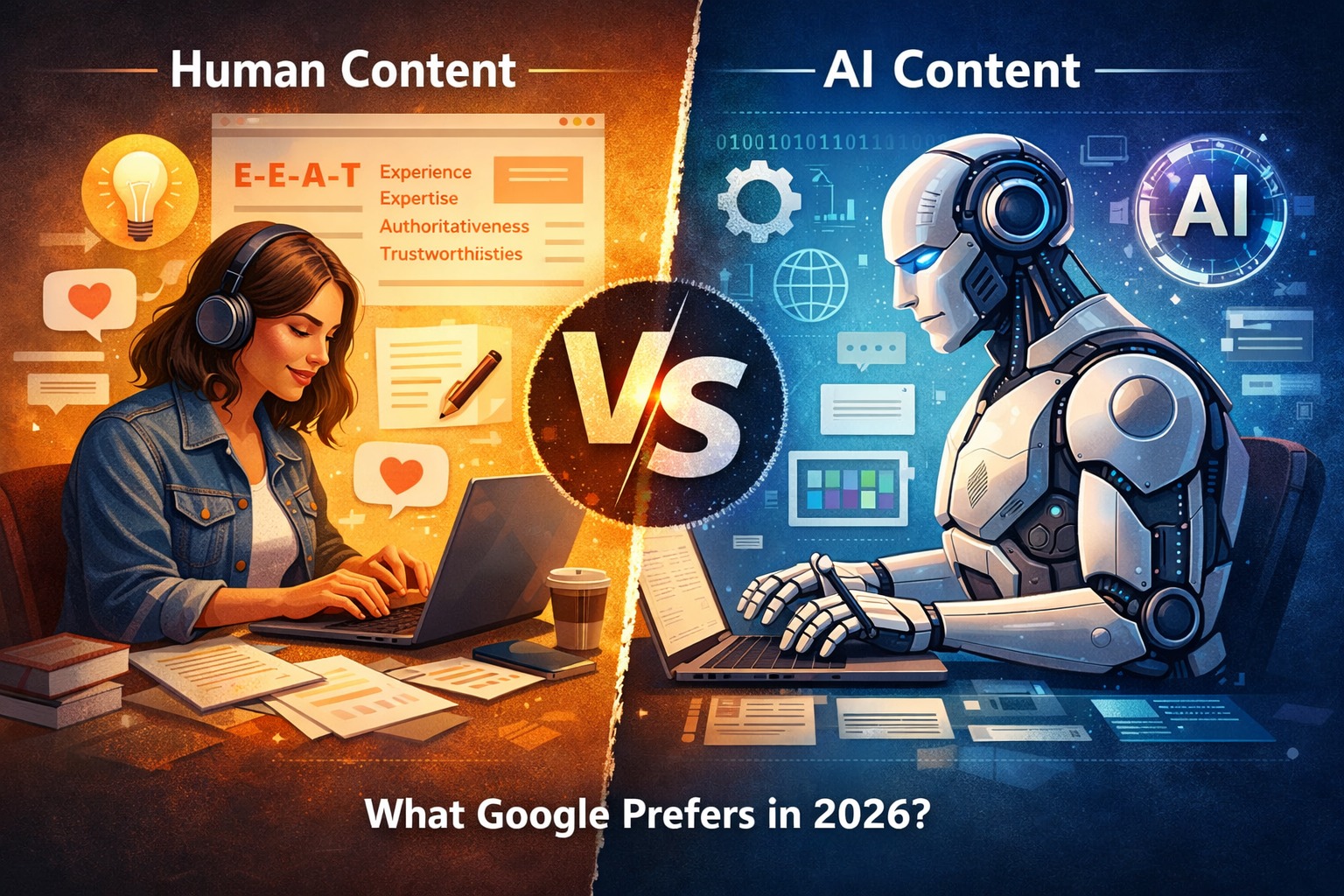
In 2026, the debate between human-written content and AI-generated content is more relevant than ever. With rapid advancements in artificial intelligence tools like ChatGPT, Gemini, and Claude, businesses and bloggers are producing content at scale. But the big question remains: What does Google actually prefer human content or AI content?
The short answer: Google prefers helpful, high-quality, and trustworthy content regardless of who (or what) creates it. However, the way content is created still plays a major role in how well it ranks.
Let’s break it down clearly.
1. Google’s Official Stance in 2026
Google does not automatically penalize AI-generated content. According to its Search Quality Evaluator Guidelines and spam policies, Google focuses on:
- Content quality
- Originality
- Expertise
- User value
- Search intent satisfaction
If AI content is created only to manipulate rankings (keyword stuffing, spinning, or mass automation), it falls under spam. But if AI is used as a writing assistant and the final output is helpful and original, it can rank well.
Key takeaway:
Google rewards value, not authorship.
2. What Makes Human Content Stronger?
Human-written content still has advantages that AI struggles to replicate fully:
a) Real Experience (E-E-A-T)
Google’s 2026 ranking system heavily emphasizes Experience, Expertise, Authoritativeness, and Trustworthiness (E-E-A-T). Humans naturally bring:
- Personal stories
- Case studies
- Industry insights
- First-hand experience
These elements improve credibility and engagement.
b) Emotional Intelligence
Humans understand tone, empathy, humor, and cultural nuance better than AI. This helps:
- Improve dwell time
- Reduce bounce rates
- Build brand loyalty
c) Unique Perspective
AI generates content based on existing data. Humans can add:
- New opinions
- Fresh angles
- Creative storytelling
- Thought leadership
3. Where AI Content Performs Well
AI content has improved dramatically in 2026 and excels in certain areas:
a) Speed and Scalability
AI can generate:
- Product descriptions
- Blog outlines
- FAQs
- Technical documentation
- Data-driven summaries
This helps businesses scale content production efficiently.
b) SEO Structuring
AI tools are excellent at:
- Keyword placement
- Meta descriptions
- Heading optimization
- Schema-ready formatting
c) Multilingual Content
AI enables fast translation and localization for global SEO strategies.
4. The Real Problem: Low-Quality AI Content
Google penalizes bad AI content, not AI itself. Red flags include:
- Repetitive phrasing
- Over-optimized keywords
- Shallow explanations
- No original insight
- Factually incorrect information
- No human editing
Mass-published, unreviewed AI articles are more likely to get deindexed or lose rankings in 2026’s AI-content filters.
5. The Hybrid Approach: What Actually Wins in 2026
The most successful SEO strategy today is Human + AI collaboration.
Best practice workflow:
- Use AI for:
- Research
- Content outlines
- First drafts
- SEO optimization
- FAQ generation
- Research
- Use humans for:
- Fact-checking
- Adding real-world experience
- Improving tone and clarity
- Storytelling
- Brand voice consistency
- Ethical and legal review
- Fact-checking
This hybrid model produces content that is:
- Faster to create
- More cost-effective
- Higher in quality
- More trustworthy
- Better optimized for rankings
6. How Google Detects Content Quality in 2026
Google’s AI ranking systems analyze:
- User behavior signals (CTR, dwell time, bounce rate)
- Content depth and coverage
- Topical authority
- Freshness and updates
- Citation accuracy
- Author credentials
- Internal linking structure
It does not rely solely on AI-detection tools. Instead, it evaluates how useful the content is to real users.
7. SEO Checklist for AI + Human Content (2026 Edition)
To stay on Google’s good side:
- ✅ Answer real user questions clearly
- ✅ Add expert quotes or first-hand experience
- ✅ Include original examples and visuals
- ✅ Use structured headings (H1–H3)
- ✅ Optimize for featured snippets
- ✅ Cite credible sources
- ✅ Keep content updated regularly
- ✅ Avoid duplicate or spun content
- ✅ Add author bio and credentials
- ✅ Improve internal and external linking
8. Final Verdict: What Google Really Prefers
Google does NOT prefer human content or AI content.
It prefers:
Helpful, original, accurate, and experience-driven content that satisfies user intent.
In 2026, the winning strategy is not choosing between human or AI — it’s using both intelligently.
If you rely only on AI:
You risk thin, generic, and untrustworthy content.
If you rely only on humans:
You may fall behind in speed, scale, and SEO efficiency.
The future of SEO belongs to hybrid content creators.
Conclusion
The debate of human vs AI content is no longer about who writes it — it’s about how well it serves the user.
Businesses that combine AI efficiency with human creativity, experience, and editorial oversight will dominate Google rankings in 2026 and beyond.
If your goal is sustainable SEO growth, focus on quality, authenticity, and value, not the tool you use.