
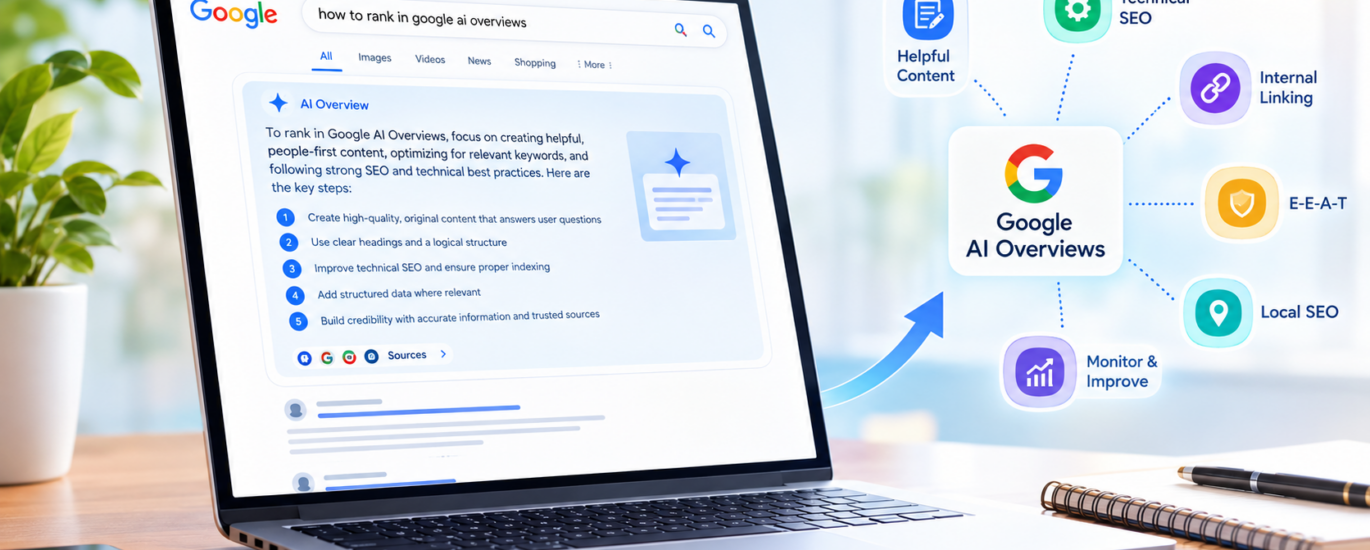
Google Search is changing. Instead of displaying only a list of website links, Google can now generate AI-powered summaries that answer users’ questions and provide links to relevant sources. These summaries, known as Google AI Overviews, are changing how people discover businesses, compare services, and find information online.
For businesses investing in search engine optimization, this creates a new opportunity: making their website content useful, trustworthy, and relevant enough to be considered as a supporting source in AI-generated search results.
However, ranking in Google AI Overviews is not as simple as adding a few keywords or installing a special plugin. Businesses need a strong SEO foundation, helpful content, clear website structure, technical accessibility, and evidence of real expertise.
In this guide, we explain how Google AI Overviews work, how to optimize your website for AI-powered search, and which practical SEO strategies businesses can implement in 2026.
What Are Google AI Overviews?
Google AI Overviews are AI-generated summaries that appear within Google Search for selected queries. They bring together information from relevant sources to help users understand a topic, answer a question, or explore a more complex subject.
For example, someone searching for “How can a small business improve its local SEO in Chennai?” may see an AI-generated overview covering Google Business Profile optimization, local keywords, customer reviews, website improvements, and local citations. The overview may also link to websites that provide useful information about these topics.
Unlike traditional search results, which primarily present individual web pages, AI Overviews synthesize information from multiple sources into a summarized response.
For website owners, this means that search visibility is no longer just about appearing among the standard blue links. Being referenced as a useful source in an AI Overview can provide another way for potential customers to discover your brand.
Google does not guarantee that any particular page will appear in an AI Overview, even if it follows SEO best practices.
Why Google AI Overviews Matter for SEO in 2026
Search behavior is becoming more conversational. People increasingly ask detailed questions instead of searching with only one or two keywords. They may want comparisons, recommendations, step-by-step instructions, or solutions to specific problems.
This creates several important opportunities for businesses.
Greater opportunities for discovery: Relevant pages may receive visibility through AI-generated summaries and their supporting links.
More specific search intent: Businesses can create content that addresses detailed questions from customers who are researching a service or considering a purchase.
Stronger brand recognition: Useful information can help a company become more familiar to people researching its industry.
Better alignment with customer needs: Content that explains problems, solutions, limitations, and next steps can support users throughout their decision-making process.
A broader SEO strategy: Businesses can improve traditional organic visibility while making their content easier to understand and use across Google’s AI-powered search experiences.
It is important to distinguish visibility from traffic. An AI Overview impression does not automatically generate a website visit or a lead. Businesses should evaluate organic traffic, qualified enquiries, conversions, and brand visibility together rather than relying on one metric.
How Does Google Select Content for AI Overviews?
Google has not published a complete formula for selecting every source used in AI Overviews. Its official guidance explains that existing SEO best practices remain relevant and that pages must meet the normal technical requirements for appearing in Google Search.
Google’s AI systems can explore related searches and supporting web pages to build a response. This means a page may be useful for a particular subtopic even when the user’s original query uses different wording.
Several foundational practices are therefore important:
- Search engines must be able to access and understand the page.
- The page should be eligible to appear in Google Search with a snippet.
- The content should directly address the user’s information need.
- The information should be accurate, useful, and supported by appropriate expertise.
- The website should provide a good overall experience.
- Structured data, where used, should match the visible content.
- The website should comply with Google’s spam policies.
There is no special AI Overview schema that guarantees inclusion, and a website does not need to adopt a separate AI-specific indexing system to qualify.
The most effective starting point is to improve the quality, clarity, relevance, and accessibility of your existing SEO content.
12 Strategies to Improve Your Chances of Appearing in Google AI Overviews
1. Create Helpful, People-First Content
Content quality should be the foundation of your AI search optimization strategy.
Many websites publish similar articles containing general definitions, repeated advice, and keyword-focused paragraphs. These pages may provide little additional value when compared with existing resources.
To make your content more useful, answer the questions your audience actually has. Explain the subject clearly, provide practical recommendations, include relevant examples, and address common misunderstandings.
For example, a generic article about SEO may explain that backlinks are important. A more useful article could explain how to evaluate backlink relevance, identify potentially harmful links, prioritize industry-specific websites, and measure the results of a link-building campaign.
The second approach gives readers more actionable information.
Before publishing, ask yourself:
- Does the article answer the main question?
- Does it offer information beyond what is already widely available?
- Are its claims accurate and verifiable?
- Can readers apply the advice?
- Does it explain limitations or exceptions where necessary?
The objective is not simply to produce more content. It is to publish content that genuinely helps people.
2. Answer the Main Question Early
Readers should not have to navigate through several paragraphs of background information before discovering the answer to their question.
Start important sections with a concise explanation, followed by supporting details, examples, and practical steps.
For instance, if your heading is “How Can You Optimize a Website for Google AI Overviews?”, the opening paragraph could be:
“To improve your website’s chances of appearing in Google AI Overviews, make sure your pages are accessible to Google Search, publish helpful and original content, organize information clearly, strengthen your website’s technical SEO, and build trust through accurate information and relevant expertise.”
You can then explain each recommendation in detail.
This structure benefits readers because it makes information easier to scan and understand. It also makes the relationship between a heading and its answer clear.
However, concise answers alone do not guarantee AI visibility. They should be part of a complete, useful page rather than a substitute for meaningful information.
3. Target Conversational and Long-Tail Keywords
People often use natural-language questions when searching for solutions. Instead of searching only for “SEO services,” a potential customer may search for:
- How can I improve my website’s Google rankings?
- What is the difference between SEO and AI search optimization?
- How can a small business generate leads through organic search?
- Which local SEO strategies work for businesses in Chennai?
- How long does SEO take to produce results?
These queries reveal different needs and levels of purchase intent.
Use keyword research to identify the questions your audience asks, then organize your content around related topics. Search Console query data, customer enquiries, keyword research platforms, and relevant industry discussions can help you discover these questions.
Do not create a separate article for every minor variation of a keyword. Combine closely related questions when they can be answered comprehensively on one page.
For example, a guide about local SEO for Chennai businesses could cover Google Business Profile optimization, local keyword targeting, location pages, reviews, citations, and performance measurement.
The aim is to address a subject thoroughly without repeating the same information across multiple pages.
4. Build Topic Clusters and Strong Internal Links
A single blog post rarely explains every aspect of a complex subject. Topic clusters allow you to develop a connected collection of useful resources.
For example, a digital marketing website could organize its SEO content around a central pillar page about search engine optimization, supported by articles on:
- Technical SEO audits
- On-page SEO optimization
- Local SEO for small businesses
- Keyword research techniques
- Link-building strategies
- Generative Engine Optimization (GEO)
- Google AI Overviews
- SEO reporting and analytics
Link these articles naturally to one another wherever the connection helps the reader.
A blog about Google AI Overviews could link to a detailed technical SEO guide when discussing crawling and indexing. A local SEO article could link to a Google Business Profile guide when explaining business information and reviews.
Internal links help users discover related resources and help search engines find pages and understand their relationships.
Use descriptive anchor text that explains what the linked page covers. Avoid adding links merely to increase their number.
5. Demonstrate Experience, Expertise, Authority, and Trust
Google discusses content quality in terms that include experience, expertise, authoritativeness, and trustworthiness, commonly abbreviated as E-E-A-T.
E-E-A-T is not a single score that website owners can directly optimize. Instead, it is a useful framework for evaluating whether your content gives readers good reasons to trust it.
You can strengthen trust by:
- Providing accurate author biographies and relevant professional experience.
- Linking to authoritative primary sources when discussing technical or factual claims.
- Sharing genuine case studies and lessons learned from real projects.
- Explaining the methods behind research or recommendations.
- Keeping business contact information and company details accurate.
- Correcting outdated or inaccurate statements.
- Avoiding unsupported statistics, exaggerated claims, and fabricated testimonials.
For a digital marketing company, a practical case study could describe the initial SEO challenge, the actions taken, the measurement period, and the observed results. Any performance figures should come from actual analytics and should be presented with the appropriate context.
A transparent explanation of what worked, what did not, and what remains uncertain is more credible than a promise of guaranteed first-page rankings.
6. Use Clear Headings and a Logical Content Structure
A well-organized page helps readers understand the topic and locate relevant information quickly.
Use one clear main heading for the article, followed by descriptive subheadings that introduce logical sections. Break complicated explanations into manageable paragraphs and use numbered instructions or bullet points when they improve readability.
For example, an article about AI Overview optimization could use the following structure:
- What Google AI Overviews are
- Why they matter for businesses
- How Google evaluates eligible content
- How to improve content quality
- Technical SEO requirements
- Structured data and common misconceptions
- How to monitor performance
- Frequently asked questions
Headings should describe the content that follows. Avoid inserting keywords into every heading when doing so makes the text awkward or repetitive.
A useful structure supports comprehension, but there is no special heading format that guarantees inclusion in AI-generated results.
7. Strengthen Technical SEO, Crawling, and Indexing
High-quality content cannot perform well in Google Search if the relevant page cannot be accessed, indexed, or shown with a search snippet.
Review the technical foundations of your website regularly.
Check indexing: Use Google Search Console’s URL Inspection tool to determine whether important pages are indexed and identify relevant indexing issues.
Review robots.txt: Confirm that Googlebot is not unintentionally blocked from crawling important content or resources.
Check meta robots directives: Make sure important pages are not accidentally marked noindex.
Review canonical tags: Ensure that canonical URLs point to the intended versions of your pages.
Improve internal navigation: Link to important pages from relevant sections of the website so users and search engines can discover them.
Submit an XML sitemap: Keep the sitemap accurate and submit it through Search Console when appropriate.
Improve mobile usability and page experience: Make sure the site works well on mobile devices, loads efficiently, and provides a clear browsing experience.
Check JavaScript rendering: If your website relies heavily on JavaScript, verify that important content and links are available to Google when it processes the page.
Review HTTPS and broken links: Maintain secure connections and fix broken internal links that interfere with navigation.
These are foundational SEO checks, not a separate technical checklist invented specifically for AI Overviews.
8. Use Structured Data Correctly
Structured data is code that helps search engines interpret information about a page or entity. Depending on the content, relevant schema types may include Article, BreadcrumbList, Organization, LocalBusiness, or Product.
For example, Article structured data can help identify an article’s headline, author, publication date, and other relevant details when those properties are accurately represented on the page.
For a business website, Organization markup may help describe the company. Breadcrumb markup can clarify the page’s position within the website’s navigation.
When implementing structured data:
- Choose a schema type that accurately describes the page.
- Ensure the marked-up information matches the visible content.
- Use required and recommended properties appropriately.
- Validate the markup with Google’s Rich Results Test when applicable and check for errors.
- Keep information such as author names and publication dates accurate.
- Avoid marking up information that users cannot see or that does not belong to the page.
Important: Structured data does not guarantee a rich result or inclusion in AI Overviews. Google does not require a special AI Overview schema. Implement markup because it accurately describes your content and supports applicable search features, not because you expect it to trigger an AI summary.
9. Publish Original Insights, Data, and Real Examples
One of the strongest ways to differentiate your website is to offer something that cannot be found in the same form on dozens of competing pages.
Consider adding:
- Original research or survey findings.
- Genuine customer questions and detailed answers.
- First-hand project observations.
- Expert commentary on industry changes.
- Practical checklists and decision-making frameworks.
- Before-and-after examples supported by real evidence.
- Screenshots or visual explanations that clarify a process.
For instance, a digital marketing agency could publish a case study explaining how it diagnosed indexing problems on a client website. The article could describe the symptoms, the investigation, the corrections made, and the results observed over a clearly stated period.
Do not disclose confidential client information or publish results that cannot be verified.
Originality does not always require conducting a large research study. A well-explained practical lesson, supported by genuine experience, can also add substantial value.
10. Optimize Images and Videos
Search visibility is not limited to written text. Images, videos, and other useful media can improve the reader’s understanding and help your website present information more effectively.
Use relevant images to demonstrate processes, explain concepts, or illustrate real examples. Write descriptive alt text for meaningful images, compress files appropriately, and avoid unnecessarily large media that slows down the page.
For videos, provide a clear title, useful description, and relevant supporting text. Where appropriate, make a transcript available so readers can access the information without playing the video.
For example, a tutorial about using Google Search Console could include screenshots showing how to inspect a URL, review indexing status, and identify performance trends.
Do not use generic stock images as a replacement for useful explanations. Every media element should serve a purpose.
11. Strengthen Local SEO for Chennai Businesses
Local SEO is particularly important for businesses that serve a specific geographic area.
A company targeting customers in Chennai should make it easy for both users and search engines to understand its services, location, service area, and business identity.
Start by maintaining an accurate Google Business Profile, including your business name, category, contact details, website, and relevant service information.
Create useful service pages that explain what you offer and who you serve. Where appropriate, publish genuinely location-specific content rather than producing nearly identical pages with only the city name changed.
Encourage genuine customer reviews and respond professionally. Maintain consistent business information across relevant directories, and earn links or mentions from legitimate local organizations and industry sources.
For example, a Chennai-based digital marketing agency could create useful resources for local retailers, professional service firms, educational institutions, and other businesses that need better organic visibility.
Local relevance should come from genuine business activity and useful information, not keyword stuffing or misleading location claims.
Remember that local SEO improvements do not guarantee inclusion in AI Overviews. They help establish a stronger overall search presence.
12. Measure Results and Improve Your Content Continuously
AI search optimization should be treated as an ongoing process rather than a one-time task.
Use Google Search Console to review organic search impressions, clicks, click-through rates, average positions, and the queries associated with your pages. Use Google Analytics or another suitable analytics platform to understand engagement, enquiries, and conversions.
Compare performance over meaningful periods and investigate which pages are gaining visibility, which are losing traffic, and which search queries are attracting relevant visitors.
If a page receives impressions but few clicks, review its search intent, title, description, and the value it communicates to users. If it receives little visibility, investigate indexing, competition, topical relevance, and content quality before rewriting it.
Keep in mind that Search Console reporting for AI features may change over time. AI Overview data is not necessarily available as a fully separate report for every website or query. Do not assume that all AI-generated search impressions can be isolated from traditional search reporting.
The most important outcome is whether your organic search presence helps the business reach the right audience and generate meaningful results.
How to Optimize Existing Blog Posts for AI Search
Publishing new articles is not always the best first step. Many websites already have useful content that could benefit from improvement.
Start with your most relevant existing blog posts and service pages.
First, identify pages that receive organic impressions or have strong business relevance. Next, compare their content with the questions users are asking and the information competing pages provide.
Look for outdated advice, incomplete explanations, unsupported claims, missing examples, weak internal links, and technical issues. Update these elements where necessary.
You can also improve the opening section, make headings more descriptive, add relevant original insights, and link to related service pages where it genuinely helps readers.
Avoid changing publication dates simply to make an article appear fresh. Update dates when appropriate and reflect substantial changes honestly.
The goal is to make the page more useful, not merely to make it longer.
Common Myths About Ranking in Google AI Overviews
Several misconceptions can lead businesses to waste time and resources.
Myth 1: You need a special AI Overview schema.
There is no dedicated schema type that guarantees inclusion in AI Overviews. Use appropriate structured data for its intended purpose.
Myth 2: You must rank number one in traditional search first.
Traditional organic visibility is valuable, but Google does not state that a page must always rank first to be considered as a supporting link in an AI Overview.
Myth 3: Adding an FAQ section guarantees AI citations.
FAQs can be useful when they answer real customer questions. Adding them solely to manipulate search results does not guarantee visibility.
Myth 4: Publishing more AI-generated articles automatically improves rankings.
AI tools can assist with research, planning, and drafting. However, large volumes of unoriginal, low-value content can violate Google’s spam policies. Review all content for accuracy and add meaningful human expertise and original value.
Myth 5: Repeating keywords improves AI Overview visibility.
Keyword stuffing makes content less natural and may violate spam policies. Use terminology that accurately reflects the topic and answers the user’s intent.
Myth 6: Backlinks alone are enough.
Relevant links can support a website’s overall authority and discoverability, but they cannot compensate for inaccessible pages or content that fails to satisfy users.
Myth 7: Every business can guarantee AI Overview placement.
No agency or SEO professional can guarantee that Google will cite a particular page in an AI Overview. A responsible strategy focuses on improving eligibility, content quality, and overall search performance.
A Practical 90-Day Plan for AI Overview Optimization
Businesses can begin with a structured three-month implementation plan. The exact timeline should depend on the website’s current technical condition, content inventory, competition, and available resources.
Days 1-30: Audit and Establish a Baseline
Review technical SEO, indexing, existing content, internal links, mobile experience, and structured data. Identify pages that are most relevant to the business and record baseline Search Console and conversion data.
Prioritize problems that prevent important pages from being crawled, indexed, or understood.
Days 31-60: Improve Content and Topical Coverage
Update existing articles, improve service pages, answer important customer questions, and add original examples. Develop related articles around core services and connect them with relevant internal links.
Review authorship, factual accuracy, page structure, image optimization, and appropriate schema markup.
Days 61-90: Monitor, Test, and Refine
Review changes in organic impressions, clicks, queries, page performance, and qualified enquiries. Investigate pages that are improving or underperforming and prioritize the next round of changes.
Where practical, monitor AI Overview appearances manually for a consistent set of relevant queries and record the date, location, language, and observed supporting links. Search results can vary, so a single observation should not be treated as proof of a lasting ranking.
At the end of the 90 days, assess what has improved and create a new action plan based on the evidence.
Frequently Asked Questions About Google AI Overviews
1. How can I get my website featured in Google AI Overviews?
Build a technically accessible website, publish useful and original content, answer relevant user questions, maintain clear internal links, and follow Google’s Search Essentials. These practices can improve your website’s eligibility and overall search quality, but they cannot guarantee inclusion.
2. Is AI Overview optimization different from traditional SEO?
The underlying fundamentals remain closely connected. Traditional SEO practices such as crawling, indexing, content quality, clear page structure, and helpful information are still important. AI search optimization places additional practical emphasis on answering complex questions clearly and providing information that is useful across related searches.
3. Does FAQ schema help websites rank in AI Overviews?
FAQ content can help users find answers when it is relevant and well written. However, FAQ schema is not a guaranteed method for obtaining AI Overview visibility, and there is no special AI Overview schema requirement.
4. Does Google prefer AI-generated content?
Google’s guidance focuses on the quality and usefulness of content rather than whether AI was used to produce it. AI can assist with content creation, but the finished article should be accurate, original, relevant, and genuinely helpful. Publishing large quantities of low-value content may violate Google’s spam policies.
5. How long does it take to appear in Google AI Overviews?
There is no fixed timeline. Results depend on factors such as crawling, indexing, query relevance, competition, and Google’s systems. Technical corrections and content improvements may take time to be processed, and appearing in an AI Overview is never guaranteed.
6. Can small businesses compete for AI Overview visibility?
Yes. Small businesses can create useful resources for specific audiences, demonstrate genuine expertise, answer detailed customer questions, and develop relevant local content. They should focus on the subjects where they can offer meaningful value rather than trying to cover every possible keyword.
7. How can I track AI Overview performance?
Start with Google Search Console and your website analytics. Monitor organic impressions, clicks, query trends, relevant landing pages, and conversions. Where available, use dedicated reporting for AI search features. If separate reporting is unavailable, record manual observations carefully and avoid treating them as comprehensive measurement.
8. Should I hire an SEO agency for AI Overview optimization?
An experienced SEO agency can help audit technical issues, improve content quality, develop a topical strategy, strengthen internal linking, and measure performance. Choose a provider that explains its methods clearly and does not promise guaranteed AI Overview rankings.
Conclusion: Build a Strong SEO Foundation for AI-Powered Search
Google AI Overviews are creating another way for people to discover useful information online. Businesses that want to adapt should focus on making their websites accessible, their content genuinely helpful, and their expertise clear.
The most effective approach is not to chase shortcuts or rely on a special AI optimization trick. It is to improve the fundamentals of SEO while creating original, trustworthy resources that answer real customer questions.
From technical SEO and content development to local search optimization and performance measurement, a consistent strategy can help businesses build a stronger organic presence as search continues to evolve.
Need help improving your website’s organic visibility?
Seven Horses Software Solutions helps businesses strengthen their digital presence through SEO, technical website optimization, content strategy, local SEO, and digital marketing services.
Visit Seven Horses Software Solutions to explore our services and discuss an SEO strategy suited to your business goals.