SEO
If you run a business page on Instagram, post reels on YouTube, or share updates on X, there’s a good chance some of that content is already showing up in Google Search you just haven’t had a way to prove it. That changes with Google’s newest Search Console feature, and if you’re serious about SEO and social media marketing in India, it’s worth understanding what it does and how to use it.
What’s New
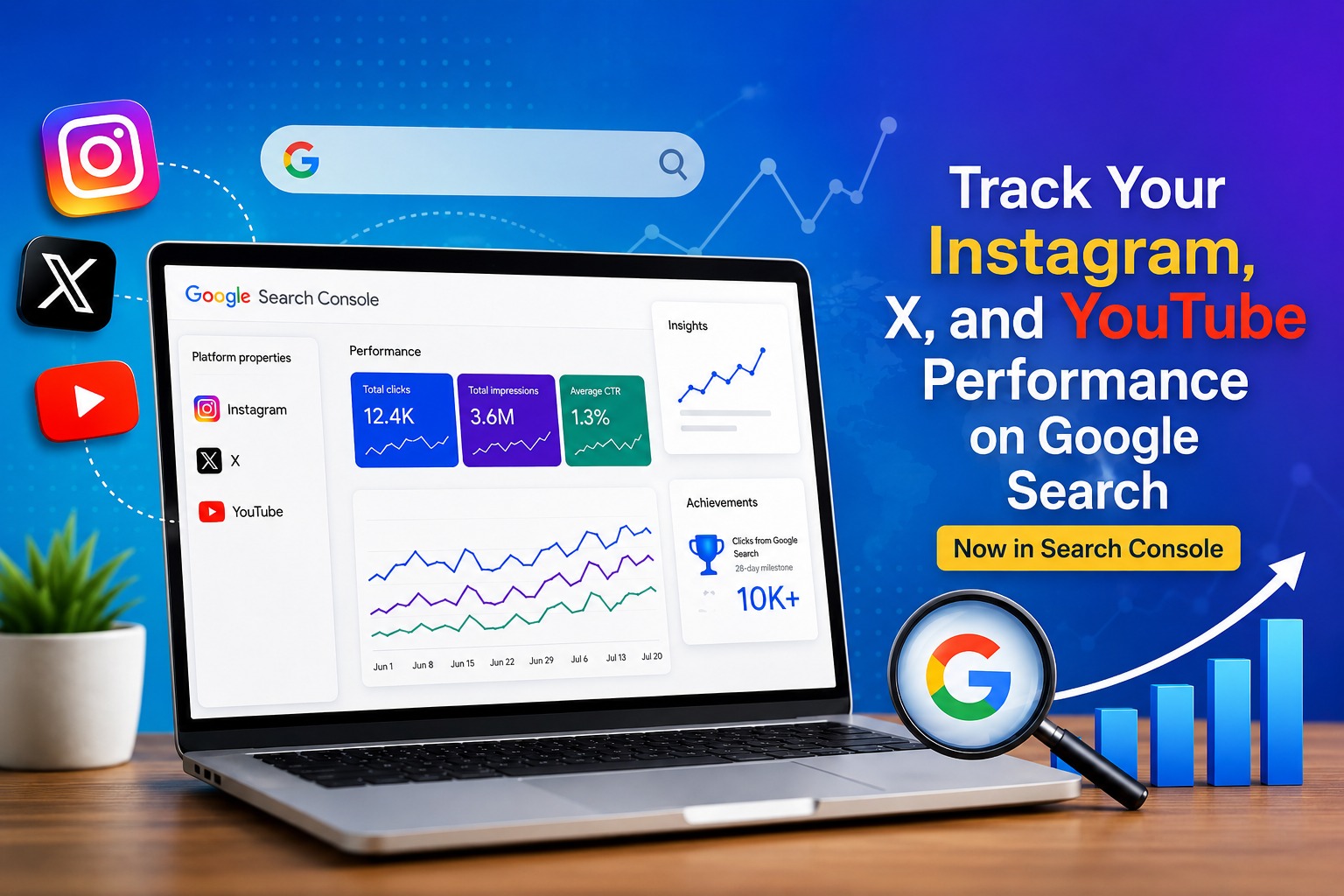
Google Search Console has introduced platform properties, a new property type built specifically for social and video content. Until now, Search Console only worked for people who owned a website domain. With platform properties, you can verify an Instagram, X, or YouTube account directly even if you don’t have a website at all and see how that content performs in Google Search and Discover.
Globally, Google has listed four supported platforms: Instagram, TikTok, X, and YouTube. Since TikTok has been banned in India since 2020, that option simply won’t apply here but the three platforms that matter most for Indian brands and creators, Instagram, X, and YouTube, are all covered. If your social strategy leans on Instagram Reels or YouTube Shorts, which is the case for most Indian businesses right now, this update is directly relevant to you.
Once verified, a platform property gives you access to three reports:
- Performance report – total clicks, impressions, and related metrics for your social and video content, the same way you’d track a website’s search performance today.
- Insights report – a summary of recent traffic trends, your best-performing posts, and how people are finding your account through Google.
- Achievements – milestone tracking, such as crossing a new threshold of clicks from Google Search over the past 28 days.
Setting one up is straightforward: open Search Console, go to the property selector, click “Add property,” choose Instagram, X, or YouTube (whichever account you want to track), and complete the verification steps for that account.
Why This Actually Matters
For years, Search Console has answered one question really well: how does my website perform on Google? But that was never the whole picture. A store walkthrough posted as an Instagram Reel, a founder interview shared on X, a product demo on YouTube all of this content can get discovered through Google Search, but until now it lived in a blind spot.
You could see likes and shares inside the platform’s own analytics, but not whether it was actually earning search visibility.
Platform properties closes that gap. It’s Google formally acknowledging that audiences don’t move in a straight line from search to website to social they jump between formats, and a social post can answer the exact same search intent as a landing page.
This is especially relevant if you’re a creator, a local business, or a brand that leans heavily on social content and doesn’t have a large website footprint. You now have a legitimate, first-party way to measure whether your social strategy is contributing to organic discovery not just engagement inside the app.
What This Means for Your Content Strategy
A word of caution before you get too excited: this doesn’t mean every caption should be rewritten like a landing page. Over-optimizing social content for search is a real risk, and it tends to strip away the very things that make that content work in the first place personality, timing, and platform native format.
The smarter approach is to use this new data diagnostically:
- See what’s already working. Check which of your existing posts and videos are earning impressions and clicks from Google Search, before you change anything.
- Look for patterns, not rules. Are certain topics, formats, or captions consistently surfacing in search? That’s a signal worth building on, not a formula to copy-paste.
- Connect it to your website data. If you also have a Search Console property for your website, compare the two. Understanding where a prospective customer first meets your brand a TikTok video or a blog post helps you plan content and budget more intelligently.
- Treat it as one input, not the whole strategy. Search visibility is a bonus outcome of good social content, not the reason to create it.
Getting Started
This rollout is happening gradually, so if you don’t see the option in Search Console yet, it should become available over the coming weeks. In the meantime, it’s a good moment to:
- Audit which of your social and video accounts would benefit most from this visibility (this is often the platform where you post most consistently).
- Make sure those accounts are set up for verification once the feature reaches you.
- Start thinking about how your social content and website content can work together, now that you’ll be able to measure both from the same lens.
Where We Come In
At Seven Horses Software Solutions, we help brands make sense of exactly this kind of shift, connecting the dots between SEO, social media marketing, and content strategy so you’re not managing three separate silos of guesswork.
Whether it’s setting up your Search Console properties correctly, building a content strategy that performs across platforms, or making sense of the data once it starts coming in, our team is ready to help you turn this update into real, measurable growth.
Want to know how your social content is really performing on Google Search? Get in touch with our team and let’s find out together.