Digital
Backlinks are still one of the strongest ranking factors in SEO. That hasn’t changed.
What has changed in 2026 is how search engines evaluate those backlinks.
First, What Is a High DA Backlink?
Domain Authority (DA) is a metric created by Moz. It scores a website from 1 to 100 based on how strong its backlink profile is.
The higher the DA:
- The stronger the domain appears
- The more trust signals it likely has
- The more ranking power it may pass (theoretically)
For example, if you receive a backlink from a well-known platform like Forbes or HubSpot, that’s considered a high-authority backlink.
On the surface, that sounds perfect.
But here’s what many people misunderstand.
Google does not use DA as a ranking factor.
DA is just a third-party estimation.
And that changes everything.
Why High DA Alone Is Not Enough Anymore
In the past, simply getting links from powerful domains could move rankings quickly.
In 2026, search engines — especially Google — analyze much more than domain strength.
They evaluate:
- The topic of the linking page
- The context around the link
- The natural placement of the link
- Whether users find the content useful
- The overall topical relationship between both websites
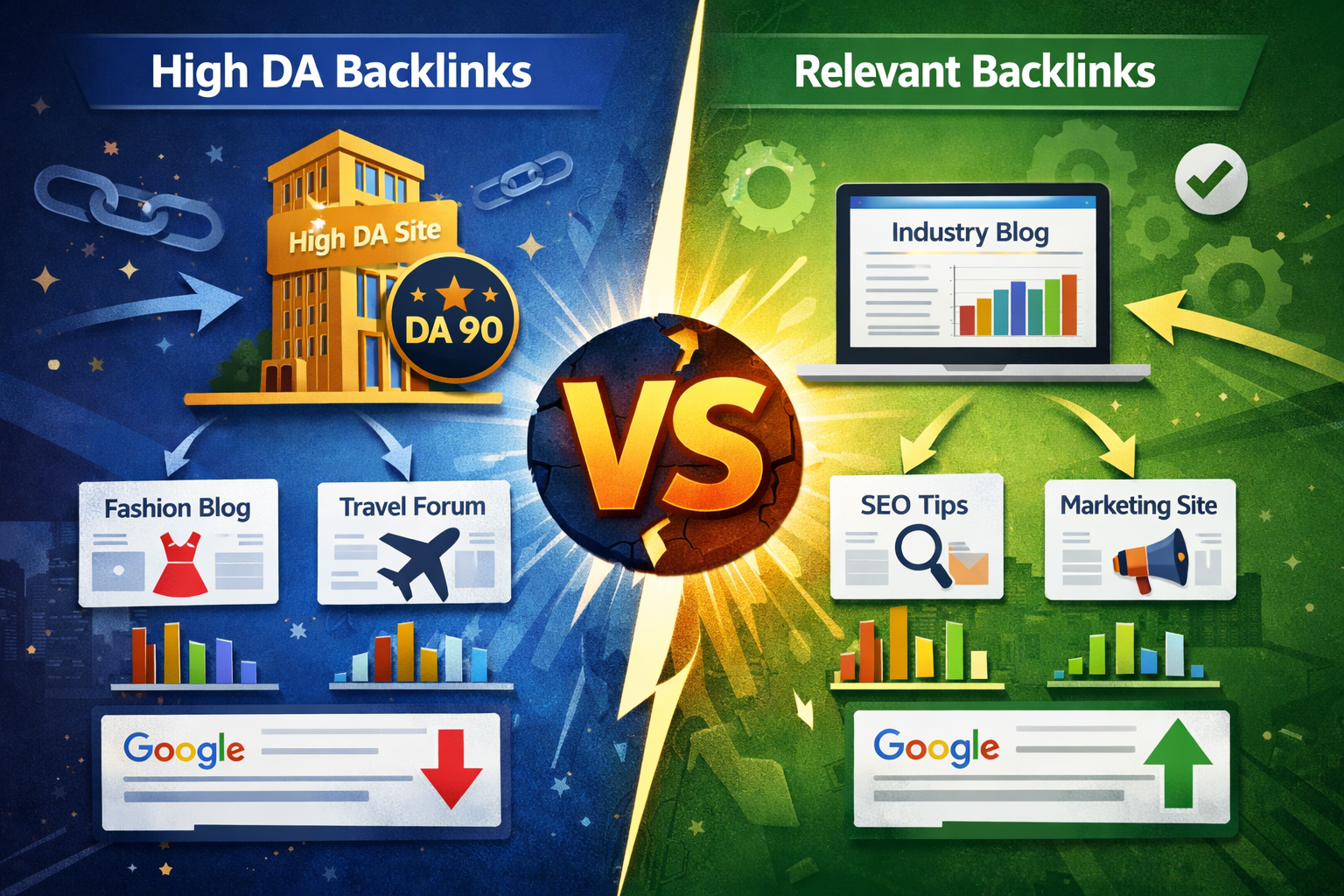
A high DA link from an unrelated website may carry very little weight.
For example:
If you run a digital marketing agency and get a backlink from a fashion blog with DA 80, that link may look impressive in a report — but algorithmically, it doesn’t strongly reinforce your marketing expertise.
Search engines now care about topical ecosystems.
And that brings us to relevance.
What Is a Relevant Backlink?
A relevant backlink comes from a website that operates in your industry or publishes related content.
For example:
If you offer SEO services:
- A link from a marketing strategy blog is highly relevant.
- A link from a tech SaaS review website discussing SEO tools is relevant.
- A link from a random entertainment blog is not relevant.
Relevance strengthens topical authority.
Why Relevant Backlinks Matter More Today
Search engines now understand content context using advanced AI systems.
They don’t just count links.
They analyze relationships between:
- Topics
- Entities
- Keywords
- Industry clusters
- Content depth
When multiple relevant websites link to you within the same niche, it builds topical authority.
That means:
- You rank faster for related keywords
- You build credibility within your industry
- Your content becomes part of a recognized knowledge cluster
This is far more sustainable than collecting random high-authority links.
Let’s Compare Two Realistic Scenarios
Scenario 1: High DA, Low Relevance
- DA 85 lifestyle website
- Article unrelated to marketing
- Generic anchor text like “click here”
- Link placed in footer or author bio
Looks impressive on paper.
But limited SEO impact.
Scenario 2: Moderate DA, High Relevance
- DA 40 marketing blog
- Article discussing SEO case studies
- Contextual link inside a paragraph about search strategy
- Anchor text aligned with your service
This link:
- Reinforces topical expertise
- Strengthens keyword relevance
- Passes contextual authority
- Improves ranking signals more effectively
In 2026, Scenario 2 often wins.
So Does High DA Still Matter?
Yes — absolutely.
Authority is still important.
But authority works best when combined with relevance.
The most powerful backlinks today have three characteristics:
- Authority – The website has trust and credibility.
- Relevance – The content aligns with your niche.
- Contextual placement – The link appears naturally inside valuable content.
For example, a contextual SEO guide published on HubSpot linking to your digital marketing case study is powerful because:
- The site is authoritative.
- The topic is relevant.
- The link placement is editorial.
That combination creates real ranking impact.
What Actually Works in 2026: A Smarter Backlink Strategy
Instead of chasing numbers, businesses should focus on strategy.
Here’s what works:
1. Build Topical Authority
Create in-depth content clusters around:
- SEO
- PPC
- Social media marketing
- Performance marketing
- Content strategy
2. Publish Niche Guest Articles
Instead of mass guest posting, focus on:
- Industry blogs
- Marketing publications
- SaaS platforms
- Business resource websites
Quality over quantity always wins.
3. Use Digital PR
Share:
- Original research
- Case studies
- Industry insights
- Survey data
Journalists and industry blogs are more likely to link when you provide real value.
4. Earn Editorial Mentions
Editorial links — where someone references your work naturally — are far more powerful than self-created links.
These are signals search engines trust the most.
Common Mistakes Still Happening in 2026
Many businesses still:
- Buy bulk high DA links without checking relevance
- Use automated backlink tools
- Submit to hundreds of outdated directories
- Over-optimize anchor text
- Focus on DA reports instead of ranking improvements
These tactics can weaken trust signals over time.
SEO today is about building authority, not manipulating metrics.
Final Answer: What Matters More in 2026?
If you must prioritize one:
Relevant backlinks matter more than high DA backlinks.
However, the ideal strategy combines both.
The best backlinks are:
- High authority
- Highly relevant
- Contextually placed
- Naturally earned
That’s what drives sustainable rankings.
Backlink building in 2026 is not about chasing the biggest numbers.
It’s about building meaningful connections within your industry.
High DA may look good in a report.
Relevance builds rankings.
And when both work together that’s when your SEO truly scales.