SEO
Search engine optimization is going through its biggest shift since Google first rolled out PageRank. Nearly 70% of Google searches today end without a single click on a website the user gets their answer straight in the results, or it’s generated by an AI system before they ever reach a page.
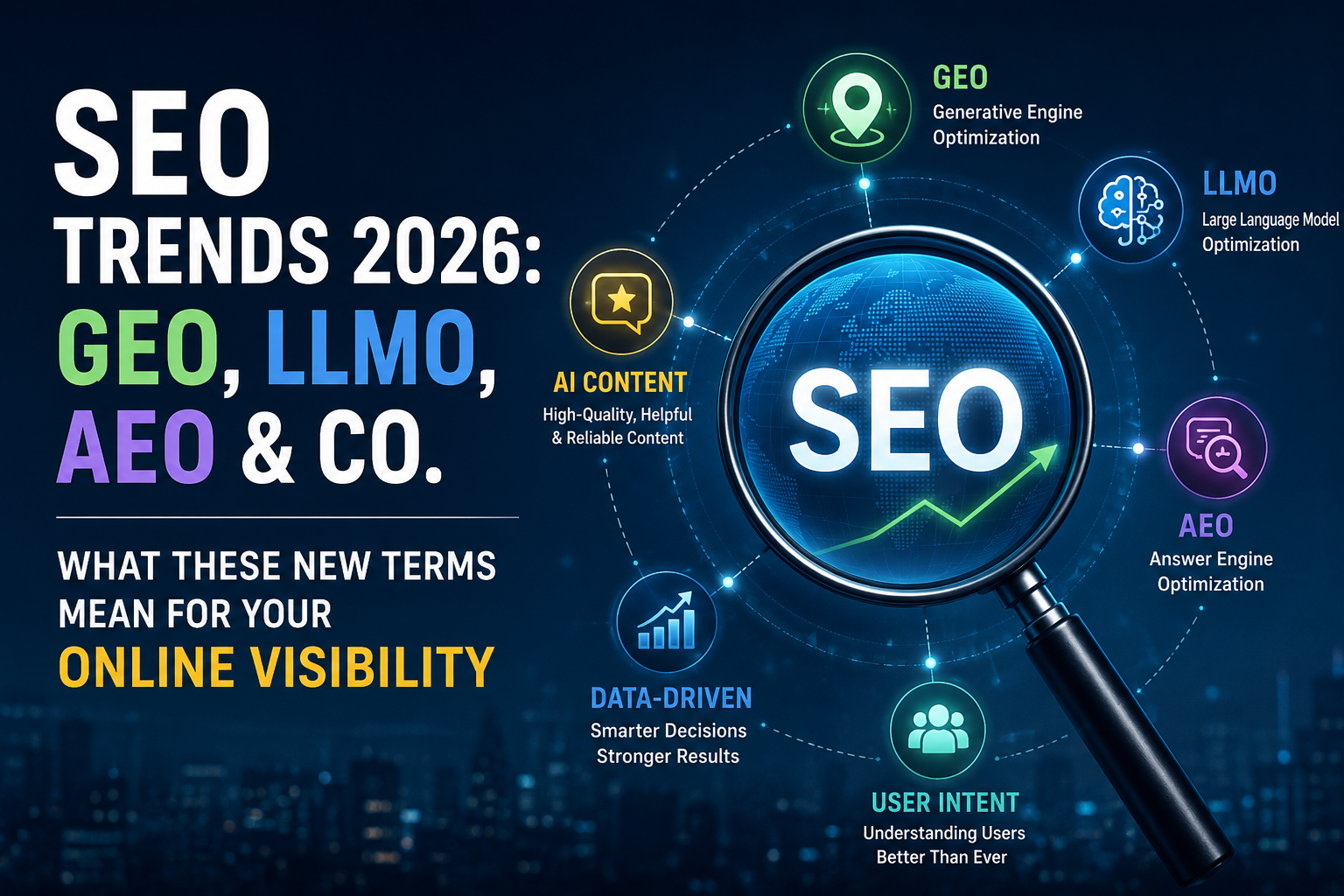
If you run a business that depends on search traffic, this isn’t a small update. It’s a rewiring of how visibility itself works. In this article, we break down the SEO trends shaping 2026 and the new acronyms GEO, LLMO, AEO, GXO, and AIO that every marketing team needs to understand this year.
Why 2026 Is a Turning Point for SEO
For two decades, “ranking on page one” was the goal. That’s no longer enough.
Instead of ten blue links, platforms like ChatGPT, Google Gemini, and Perplexity now hand users a synthesized answer pulled from multiple sources often without sending a single visitor to the original website. Search has quietly evolved from a directory of links into an answer engine.
For businesses, this means two things have to happen simultaneously:
- You still need to rank well on traditional search engines.
- Your content needs to be structured, trustworthy, and citable enough that AI systems choose to reference and credit your brand when generating answers.
This is exactly where the new discipline of AI-visibility optimization comes in, and why it’s no longer optional for companies that want to stay discoverable in 2026 and beyond.
Classic SEO vs. SEO in 2026
| Aspect | Classic SEO | The 2026 Extension |
|---|---|---|
| Focus | Keywords & rankings | Entities & semantic relationships |
| Success metric | Clicks & traffic | AI visibility & brand mentions (zero-click) |
| Content strategy | Optimizing individual pages | Content clusters & entity mapping |
| Technical foundation | Performance & indexability | Structured data, server-side rendering, API readiness |
| Primary channel | Google search | Multi-engine: ChatGPT, Perplexity, Gemini & more |
| Audience | Human users | Human users + AI agents |
| Trust signals | Backlinks & domain authority | Third-party mentions & model context |
Nothing on the left column disappears it’s the foundation. But the right column is where the competitive advantage will be won in 2026.
The Five SEO Trends Defining 2026
1. Generative Search Becomes the Default
AI Overviews on Google, Copilot on Bing, and standalone tools like Perplexity are no longer experimental they’re the default way many users search. To be included in these AI-generated answers, your content needs structured data, clearly stated answers, and demonstrable authority on the topic.
2. Voice Search and Conversational Queries Are Rising
People phrase questions the way they’d speak to another person “Which pediatric dentist near me is open on weekends?” instead of “pediatric dentist [city].” Content built for this shift needs a conversational tone, strong long tail coverage, and direct, quotable answers.
3. Entities Are Replacing Isolated Keywords
Large language models don’t just match keywords they understand entities and how those entities relate to each other (a brand, its products, its certifications, its locations). Businesses that build topical authority and clearly link related concepts together will out-perform those still chasing individual keywords.
4. Multimodal Content Is Gaining Weight
Modern AI models can analyze images, video, and documents, not just text. That means detailed alt text, transcribed videos, and consistent messaging across every format and channel are becoming ranking factors in their own right.
5. Zero – Click Visibility Still Has Value
Being cited as a source inside an AI-generated answer builds brand trust and recognition even if the user never clicks through. The new goal isn’t just traffic. It’s authoritative presence, wherever the answer is being generated.
Decoding the New Acronyms: GEO, LLMO, AEO, GXO & AIO
The rise of AI-driven search has produced a small alphabet soup of new optimization disciplines. Here’s what each one actually means and why the distinctions matter.
GEO – Generative Engine Optimization
GEO is the practice of optimizing your content specifically so generative AI tools like ChatGPT, Gemini, Perplexity, or Claude treat it as a trustworthy source and cite it in their answers.
One striking data point: in AI-driven discovery queries, roughly 85% of brand mentions come from third party content, and only around 13% originate from a brand’s own domain. That single stat should reshape how you think about PR, guest content, and off-page strategy GEO succeeds or fails largely outside your own website.
GEO relies on clearly structured content with strong headings, consistent terminology across your site, credible source references, and where possible direct technical integrations with AI platforms.
LLMO – Large Language Model Optimization
LLMO is the broader cousin of GEO. While GEO focuses on generative search engines, LLMO covers the entire landscape of AI tools chatbots, virtual assistants, copilots, and everything in between.
The best practices are practical and achievable: a clean H2/H3 heading structure, consistent naming for the same entities throughout your site, complete context within each section (don’t assume the reader has read the paragraph above), and proper schema markup so machines can categorize your content correctly.
AEO – Answer Engine Optimization
AEO is about winning “Position Zero” featured snippets, voice assistant answers, and chatbot responses. The playbook: answer the core question directly in your first paragraph, structure content around FAQs, and target long-tail, question-based search phrases.
GXO – Generative Experience Optimization
GXO looks beyond content and into the entire experience AI systems and their users have with your brand including agentic commerce, where AI agents increasingly complete tasks (like purchases) on a user’s behalf, with little to no human input at each step.
GXO covers multimodal content, integration with agentic commerce protocols, a consistent brand experience across every AI platform, and an API-first architecture that lets AI agents interact with your business directly.
AIO – Artificial Intelligence Optimization
AIO is the umbrella term that ties everything together GEO, LLMO, AEO, and GXO combined into a single, holistic AI-visibility strategy that spans technical integration, content, and user experience.
Entity Mapping: The Foundation Beneath GEO and LLMO
Before any of the tactics above will work well, your brand needs a clear entity map a documented picture of your brand, products, categories, certifications, locations, and the relationships between them.
A simple five step process to build one:
- Define your entities. Example: Parent brand → sub-brand → product category → material → certification.
- Map the relationships. “Sub-brand X is part of Brand Y,” “Product contains Material Z,” “Material carries Certification A.”
- Assign content to each entity. Every entity should have a dedicated home — a brand page, category page, FAQ section, or detail page.
- Reinforce it technically. Use semantic HTML, Schema.org markup, and deliberate internal linking to make these relationships explicit to machines.
- Verify comprehension. Use entity-analysis tools to check how clearly AI systems understand the relationships you’ve built.
AI systems consistently favor brands whose entity relationships are easy to parse. The clearer your structure, the more likely you are to be cited when someone asks an AI system a question in your category.
The AI Agentic Web: A New Layer of the Internet
Alongside the traditional, human-facing web, a parallel layer is emerging one built specifically for AI agents to interact directly with businesses via APIs and protocols such as MCP (Model Context Protocol) and ACP (Agentic Commerce Protocol).
Industry projections suggest AI agent traffic to websites could grow by roughly 30% by 2030. That means two parallel priorities for every business: keep improving the human experience on your site, and build the API-first infrastructure that lets AI agents interact with your business directly.
A Practical Example: AI-Native Shopping Feeds
E-commerce offers one of the clearest illustrations of where this is heading. Platforms like ChatGPT now support dedicated product feeds not built for click-through-rate optimization, but built so AI systems can confidently understand, categorize, and recommend a product.
Setting one up generally involves:
- Registering with the platform to gain feed access, typically through an API or partner program.
- Structuring your product data – titles, descriptions, prices, availability, images, categories, IDs, and URLs in a standard feed format (CSV, TSV, XML, or JSON).
- Keeping the feed current, ideally refreshed every 15 minutes so prices and stock levels stay accurate.
- Including trust signals, such as return rate and popularity metrics, which influence how confidently an AI system recommends a product.
- Adding contextual fields, like common Q&A and product relationships (accessories, alternatives, bundles), so the AI understands the product in context rather than in isolation.
- Controlling visibility, deciding whether products can appear in AI-assisted shopping conversations or be purchased directly within a chat interface.
The bigger lesson here isn’t feed formatting it’s a mindset shift. The competitive edge in 2026 e-commerce isn’t just performance marketing; it’s data cleanliness. AI systems can only recommend what they clearly understand, which makes accurate, well-structured product data a genuine business asset.
Building Your 2026 SEO Strategy: A Practical Framework
- Understand where your audience actually searches. Google, ChatGPT, Perplexity, voice assistants, or in-app search all behave differently and each may call for a different content format (blog, FAQ, guide, or API documentation).
- Organize content around entities, not isolated keywords. Build topic clusters that cover every facet of a subject, cleanly interlinked and backed by schema markup.
- Structure content for machines as well as people. Many AI crawlers render JavaScript poorly or not at all, so critical content should be server-rendered with a clean heading hierarchy, short paragraphs, and clear definitions.
- Use structured data consistently. Schema.org markup (Article, FAQ, LocalBusiness, Product, etc.), paired with semantic HTML, makes your content legible to both humans and machines.
- Strengthen authority on-page and off-page. Verifiable, high-quality content and clear “about us” sections build on-page trust but backlinks, reviews, and mentions in credible third-party sources matter just as much, since AI systems weigh external signals heavily.
- Manage AI bot access deliberately. Not every bot serves the same purpose some index for search, others gather training data, others power real-time assistants. Decide, with intent, which bots get access to what.
- Monitor your AI visibility regularly. Check how your brand is represented across ChatGPT, Perplexity, and Gemini. Are the answers accurate? Are your key differentiators showing up? This kind of monitoring is becoming a standard part of analytics, not an afterthought.
Accessibility: An Underrated GEO Advantage
Here’s a connection that surprises a lot of marketing teams: accessibility and AI readability largely overlap. A page that’s easy for a screen reader to interpret is usually also easy for an AI crawler to interpret.
That means meaningful alt text, clear link and button labels, a logical heading hierarchy, semantic HTML, and captions or transcripts for video content all pull double duty. Studies have linked improved accessibility with measurable gains in organic traffic and keyword visibility making it one of the few SEO investments that benefits users and AI systems at the same time.
Three Things You Can Do This Week
You don’t need a full website overhaul to start improving your AI visibility. Here are three quick wins:
1. Audit your current AI visibility (about 30 minutes). Run 5-10 searches relevant to your industry through ChatGPT, Perplexity, and Gemini. Is your brand mentioned? Is the information accurate? Which competitors are showing up instead of you? This single exercise tells you exactly where you stand today.
2. Build or upgrade your FAQ page (about 2 hours). Gather your ten most common customer questions, answer each in two to three short paragraphs, and mark it up with FAQ schema. This page does double duty for featured snippets and AI-generated answers.
3. Check how your site renders without JavaScript (about 1 hour). Disable JavaScript in your browser and revisit your key pages. If the core content disappears, that’s a strong signal to prioritize server-side rendering many AI crawlers can’t see what a browser without JavaScript can’t either.
The Bottom Line
SEO in 2026 is no longer just about ranking on Google. Technical SEO and solid on-page fundamentals remain essential, but real visibility is increasingly happening inside generative, conversational, AI-driven environments.
GEO, LLMO, AEO, GXO, and AIO aren’t just buzzwords to memorize they’re different lenses on the same underlying goal: making sure your brand shows up, accurately and credibly, wherever your audience is asking questions. Whether that question comes from a person typing into Google or an AI agent making a purchase decision on someone’s behalf, the businesses that structure their content and data around entities, authority, and machine readability today will be the ones AI systems trust tomorrow.
The shift is already underway. The businesses that adapt now – rather than waiting for AI search to become “mainstream enough” will hold a real advantage over the next few years.
Want to know where your brand currently stands in AI-generated search results? Get in touch with the Seven Horses team for a visibility audit and a strategy built for both traditional and AI-driven search.