
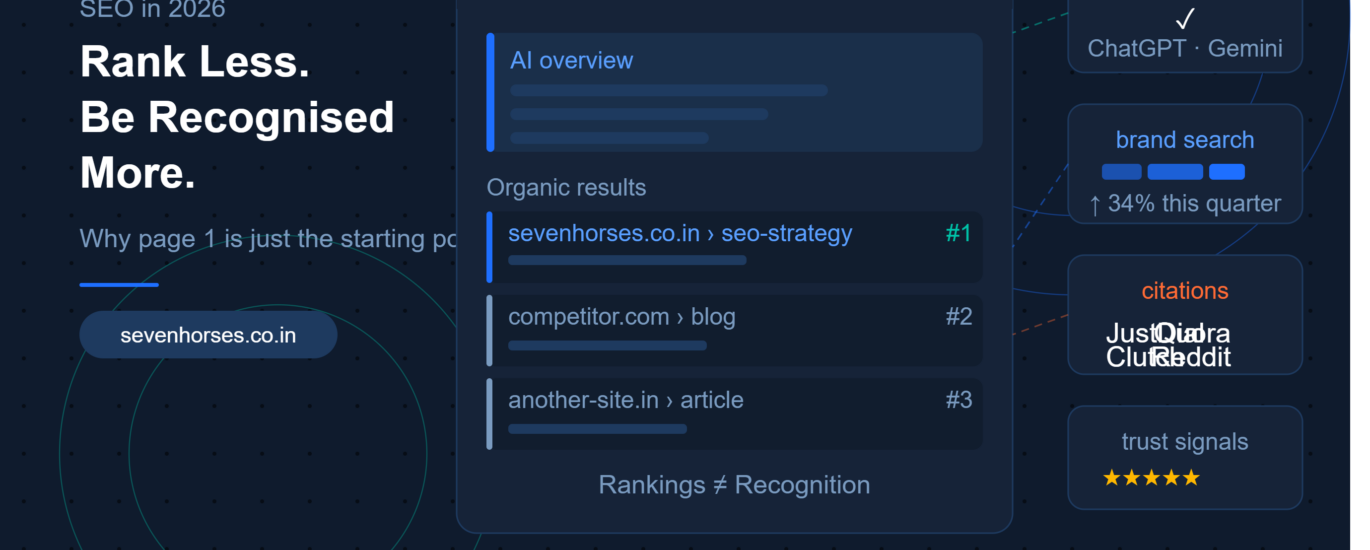
For years, every digital marketing conversation in India ended the same way: “Are we on page 1?” That single question shaped budgets, defined success, and became the go-to metric for whether SEO was “working.”
But here’s the reality check: ranking on page 1 of Google in 2026 no longer guarantees that your target audience will actually find you or choose you.
The rules have quietly changed. And most businesses haven’t noticed yet.
The Page 1 Promise Is Shrinking
Think about the last time you Googled something important a service provider, a product, a solution to a business problem. How many results did you actually click?
If you’re like most users today, the answer is fewer than it used to be. Here’s why:
Google’s own SERP has changed dramatically. Before you even see the traditional blue links, a modern search results page is packed with:
- AI-generated overviews that answer the query directly
- Featured snippets pulling content from ranked pages
- People Also Ask boxes that expand inline
- Google Maps results, ads, shopping panels, and knowledge cards
The organic “page 1” that SEOs optimised for in 2015 or even 2020 looks nothing like the page 1 of today. Ranking in position 4 used to be enviable. Today, it may well sit below the fold invisible to a user who got their answer from an AI summary before they ever scrolled.
This isn’t a reason to abandon SEO. It’s a reason to rethink what you’re optimising for.
Meanwhile, Users Have Moved On Too
Search behaviour has shifted as significantly as the results page itself.
Indian consumers particularly in metros and Tier 1 cities are increasingly using AI tools like ChatGPT, Perplexity, and Google’s own AI features to research before making decisions. They’re asking conversational questions, comparing options, and forming preferences without necessarily clicking through to websites.
Consider how a user researching, say, a digital marketing agency in Bangalore actually behaves now:
- They might start with a ChatGPT or Gemini query asking for recommended agencies
- Move to a Google search that returns an AI overview with three named brands
- Check reviews on Justdial, Google Maps, or LinkedIn
- Look up the agency on Instagram or LinkedIn to gauge their work and credibility
- Then visit the website already having formed an opinion
At which step did rankings matter? Step 2, partially. Every other step depended on something entirely different: recognition, presence, and trust built outside your own website.
If your brand only exists on your own domain, you’re invisible in most of that journey.
What AI Systems Actually Look For
Here’s where it gets particularly important for businesses investing in SEO today.
When a user asks an AI tool “which digital marketing agencies in Chennai are good for SEO?” that tool isn’t running a real-time Google search. It’s drawing on everything it was trained on and continues to learn from: industry publications, review platforms, forum discussions, directory listings, social content, news coverage, and patterns of citation across the web.
The brands that appear in those AI-generated answers are not necessarily the ones with the best-ranking website. They’re the ones that have accumulated recognition and mentions across the broader web ecosystem.
This creates an invisible gap that many businesses are falling into right now. Their website ranks well. Their technical SEO is solid. But when a potential customer asks an AI tool for a recommendation, they don’t come up because their brand presence outside their own website is thin.
This is the recognition deficit. And it’s becoming the single biggest missed opportunity in Indian digital marketing.
Recognition Is Not the Same as Brand Awareness
When marketers hear “brand visibility,” they often think of expensive brand campaigns – TV, OOH, mass media. That’s not what we mean here.
Recognition, in the context of modern SEO, has very specific and measurable components:
1. Consistent Brand Description Across Platforms
How is your business described on your website, your Google Business Profile, your LinkedIn page, your IndiaMART or Justdial listing, and your social media bio?
If each platform tells a slightly different story different services listed, different USPs highlighted, different city coverage mentioned then you have what’s called an entity clarity problem. Search engines and AI systems struggle to build a reliable picture of who you are and what you do.
The fix is straightforward: write one clear, accurate, jargon-free paragraph that describes your business. Then make sure it’s consistently reflected everywhere you exist online. This consistency is what allows Google’s Knowledge Graph and AI tools to confidently represent your brand.
2. Third-Party Mentions and Citations
Does your business appear in content that you didn’t create or control? That means:
- Being mentioned (even without a backlink) in industry articles or news coverage
- Appearing in “best of” lists, local directories, or community recommendations
- Getting cited in blog posts or videos by other creators in your niche
- Reviews and discussion on platforms like Google Maps, JustDial, Clutch, or relevant Reddit and Quora threads
Every mention outside your own domain strengthens the signal to both search engines and AI systems that your brand is real, established, and trusted by others. This is fundamentally different from traditional link building it’s about contextual presence, not just links.
3. Topical Association
For any given subject area relevant to your business, is your brand consistently associated with it’s not just by your own content, but by how others reference you?
For a digital marketing agency, for example, the goal isn’t just to rank for “SEO services in India.” It’s to be the name that surfaces when someone discusses local SEO for e-commerce, or social media strategy for D2C brands, or Google Ads management for SMEs. That kind of topical ownership doesn’t come from keyword optimisation alone. It comes from sustained contribution to the conversation in your space.
What This Means Practically for Indian Businesses
Here’s where we make this actionable. If you’re a business owner or marketing manager in India wondering whether your current SEO strategy is future-ready, ask yourself these questions:
1. Is our brand name appearing in places we didn’t create? Search your brand name in Google. Look at what comes up beyond your own website. If it’s mostly your own pages and maybe a Google Business Profile, you have a recognition gap to address.
2. What does an AI tool say about us? Ask ChatGPT or Perplexity: “What are some good [your service] providers in [your city]?” If your business doesn’t come up, that’s a meaningful signal — and it will only become more important as AI-assisted search grows.
3. Are we creating content worth citing? There’s a difference between content that ranks and content that gets referenced. Original data, detailed how-to guides, case studies with real numbers, and clear frameworks are the kinds of assets that other creators, journalists, and AI tools want to reference. If your blog is mostly generic listicles, ask whether anyone outside your team would genuinely want to cite it.
4. Is our entity information consistent? Do a quick audit: your website About page, Google Business Profile description, LinkedIn company description, and any directory listings. Are they telling the same story? If not, inconsistency is costing you recognition.
The Metrics That Now Matter Alongside Rankings
Rankings still matter, we’re not saying abandon your position tracking or stop working on organic search performance. We’re saying they should share the dashboard with newer, equally important signals:
Branded search volume: Are more people searching specifically for your brand name over time? Growth here is one of the clearest indicators that your recognition-building is working.
Brand + intent searches: When people search for your brand, are they pairing it with buying signals? (“Seven Horses digital marketing pricing” or “Seven Horses SEO review” are far more valuable than just “Seven Horses”.)
Unlinked brand mentions: Tools like Google Alerts or Ahrefs Content Explorer can surface instances where your brand is mentioned online without a backlink. These are recognition signals even without link equity.
Referral traffic from quality sources: Are niche publications, industry communities, or respected blogs sending traffic your way? The quality of referral sources matters as much as their volume.
Direct traffic growth: When more users type your URL directly or search your brand and click your site, it signals they already know who you are — they’re not discovering you, they’ve chosen to come back.
The Compound Effect of Recognition
The businesses that will win in search over the next three to five years are not necessarily those with the most technically perfect websites. They’re the ones that have built genuine authority and presence across the web, so that when a user asks an AI for a recommendation, when a journalist needs a source, when a potential customer does a brand check before calling, they consistently appear.
This takes longer than ranking for a keyword. There’s no shortcut. But it’s also far more durable.
A ranking can be lost to a Google update overnight. Recognition, built through genuine presence, consistent expertise, and third-party validation, compounds over time and becomes extremely difficult for competitors to displace.
The question every business should now be asking their digital marketing partner is not just “where do we rank?” but “are we being found, mentioned, and recommended across every channel our customers use?”
That’s the shift. And the businesses that make it early will have a substantial head start.
How Seven Horses Approaches This for Clients
At Seven Horses, our approach to SEO has always centred on building real, sustainable visibility not chasing algorithm shortcuts. Whether it’s developing entity-consistent brand profiles across platforms, building citation presence in relevant directories and publications, creating content designed to earn references rather than just rank, or integrating search strategy with social and PR efforts, our work is designed for how search actually works today and where it’s headed.
If you want to understand how your current digital presence holds up under the new rules of visibility and what it would take to close the recognition gap – let’s talk.
Seven Horses is a digital marketing agency helping Indian businesses build search visibility that lasts. Our services include SEO, Google Ads, social media marketing, and content strategy.