
Every few years, a wave of panic sweeps through marketing teams. Traffic dips. A Google update rolls out. Someone posts a dramatic thread saying “SEO is dead.” Their peers share it. Clients forward it. And suddenly, everyone is questioning whether they should redirect their entire budget to Instagram Reels.
2026 is one of those years-except this time, the panic has a more legitimate trigger than usual.
AI Overviews are reshaping how Google’s results page looks. ChatGPT is answering questions that used to send users to websites. Organic click-through rates on certain query types have genuinely dropped. If you’re managing an Indian business’s digital presence and your traffic reports look worse than last year, your instinct to ask “is something fundamentally broken?” is reasonable.
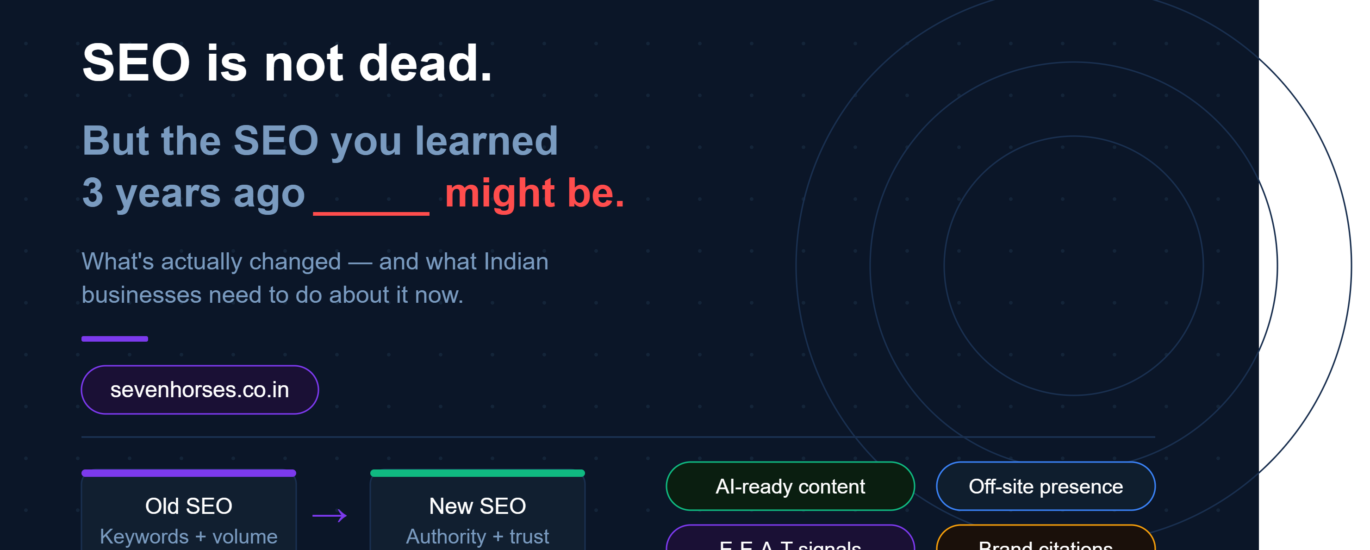
Here’s our direct answer: SEO is not dead. But a specific version of SEO – the one built on keyword stuffing, bulk content, and chasing position numbers is absolutely finished. And for Indian businesses still running that playbook, the impact is already showing up in their GSC data.
Let’s break down what’s actually changed, what still works, and what you should do about it.
What’s Actually Causing the Panic?
Before we declare anything dead or alive, it helps to understand the specific changes driving the anxiety.
AI Overviews have changed what page 1 looks like. On a growing share of informational queries, Google now places an AI-generated summary at the very top of the results page before any organic listing. A user searching “how to improve website speed” may read a perfectly adequate answer without ever scrolling to the blue links. Your page could rank #1 and still get fewer clicks than it did two years ago.
Zero-click searches have grown. Search behaviour data shows that a significant share of Google searches particularly informational ones now end on the results page itself. Users get what they need from a snippet, a Knowledge Panel, or an AI Overview and move on. This is a real shift in click behaviour, not a measurement glitch.
ChatGPT and other AI tools are becoming discovery platforms. A rising number of Indian users particularly in urban, tech-savvy demographics are increasingly turning to AI chat tools to research services, compare options, and make decisions. These tools don’t always send users to websites. And if your brand has no presence in the sources these tools draw from, you’re invisible in that channel entirely.
So yes: the environment has genuinely changed. Traffic to generic blog content has declined meaningfully for sites without strong brand authority. Ranking #1 for an informational keyword no longer guarantees the click volume it once did.
But here’s the crucial distinction: organic search as a channel is not failing. Generic SEO content is failing.
The Numbers That Don’t Make It to the Panic Thread
When people share “SEO is dead” takes, they rarely include the data that complicates that narrative. A few things worth knowing:
Google still dominates web discovery in India. Despite the rise of AI tools and social search, the vast majority of online journeys that end in a purchase, a form submission, or a business inquiry still begin with a search engine. WhatsApp referrals, Instagram discovery, and AI chat are growing but they’re growing alongside search, not replacing it at the scale that would justify abandoning organic.
The businesses that are hurting most from current changes are those that built their SEO strategy on thin, generic content designed to rank rather than to genuinely answer questions. A travel blog with 200 posts that are all shallow summaries of destinations? That’s in trouble. A regional logistics company with 12 well-researched, specific pages covering their service area, process, and client results? Still getting consistent, quality traffic.
Transactional searches – the ones where users are trying to find a vendor, book a service, or make a purchase remain largely unaffected by AI Overviews. AI tools are not completing purchases on behalf of users. When someone in Bangalore searches for “digital marketing agency for e-commerce” or a Mumbai manufacturer looks for “GST-compliant invoicing software,” they’re going to click through. The AI isn’t going to close that deal for you.
What SEO Looks Like in 2026
The version of SEO that’s evolving and thriving in 2026 has a different shape than the one many Indian businesses were sold five years ago. Here’s what’s changed at the practice level:
Content depth over content volume
The old model was: publish as many keyword targeted pages as possible. The new model is: publish fewer pieces that genuinely cover a topic comprehensively, with real insight, specific examples, and original perspective.
Google’s quality signals have become sophisticated enough to distinguish between content that was written to rank and content that was written to actually help someone. AI systems, which are increasingly influencing what appears in search results, are even better at this distinction. A 2,500-word article that covers every angle of a topic, answers follow-up questions, and provides actionable guidance outperforms five 500-word pages on related keywords every time, in the current environment.
For Indian businesses, this means fewer but better blog posts. It means service pages that actually explain your process, address objections, and give potential clients something to evaluate not just a keyword stuffed paragraph and a contact form.
Who wrote it matters more than ever
Anonymous content is losing ground. Google’s E-E-A-T framework which evaluates Experience, Expertise, Authoritativeness, and Trustworthiness increasingly rewards content that can be traced back to a real person with genuine credentials in the subject.
For a digital marketing agency blogging about SEO: who’s writing those posts? Are they named? Do they have a LinkedIn profile, bylines elsewhere, or any public credibility in the field? For an Ayurvedic clinic writing about wellness treatments: is it authored by the doctor or practitioner? Or is it unsigned filler?
This is not just a Google ranking signal. It’s also a significant factor in whether AI tools cite your content when answering user questions. AI systems strongly favour third-party, named, credentialed content over anonymous owned content.
Off-site presence is no longer optional
Here’s a shift that many Indian businesses haven’t fully absorbed yet: ranking in 2026 is not just about what’s on your website. It’s about what exists about you across the wider web.
AI systems including the ones powering Google’s AI Overviews are trained and operate on a vast ecosystem of content beyond your domain. Business directories, industry publications, news coverage, forum discussions, review platforms, and social content all contribute to how these systems understand and represent your brand.
If a user asks ChatGPT or Gemini to recommend a digital marketing agency in Chennai, the brands that come up are not necessarily the ones with the best-ranking websites. They’re the ones that have accumulated presence, mentions, and citations across the sources those systems learn from.
For Indian businesses, this makes platforms like JustDial, Clutch, IndiaMART (where relevant), Google Business Profile, industry portals, and local news sites increasingly important not just for direct traffic, but for the broader footprint that search and AI systems evaluate.
Technical fundamentals still matter – but differently
Page speed, mobile optimisation, Core Web Vitals, structured data markup these haven’t gone away. If anything, structured data (particularly JSON-LD schema for your business type, services, FAQs, and reviews) has become more important as AI systems use it to accurately represent businesses in generated results.
What’s changed is the priority hierarchy. Three years ago, a technically perfect website with thin content could still rank reasonably well. Today, technical excellence is table stakes necessary but not sufficient. Content quality, author authority, and off-site presence determine who wins in a competitive space.
The GEO Question: Do You Need Something Entirely New?
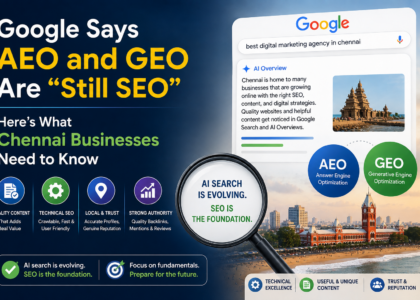
You may have seen the term “Generative Engine Optimisation” (GEO) appearing in digital marketing content lately. It refers to optimising your content not just for traditional search rankings but for inclusion in AI-generated answers the kind that appear in ChatGPT, Perplexity, Google AI Overviews, and similar tools.
The practical question for Indian businesses: do you need a separate GEO strategy, or does good SEO cover it?
The honest answer is that GEO and SEO are more complementary than they are separate. The tactics that make content suitable for AI citation clear structure, Q&A formatting, named authors, specific and verifiable claims, off-site mentions on credible platforms are largely the same tactics that make content rank well in organic search.
What GEO does add is a shift in how you measure success. If your content is appearing in AI-generated answers, that’s a meaningful form of visibility – even when it doesn’t produce a direct click. Users who encounter your brand in an AI recommendation are being influenced, even if they don’t immediately navigate to your website. Tracking branded search volume, direct traffic trends, and mention frequency alongside traditional rankings gives you a more accurate picture of actual search presence.
What Indian Businesses Should Do Right Now
If you’ve read this far, you’re probably trying to figure out what this means practically for your own digital marketing strategy. Here’s a concrete starting point:
Audit your existing content honestly. Go through your blog and service pages and ask: does this genuinely help someone, or does it exist purely to target a keyword? Pages that exist only to rank with no real depth, no original insight, no clear intended reader are not just ineffective. They can actively drag down the quality perception of your entire domain. Better to prune or consolidate weak content than to keep adding to a site that’s losing trust.
Check your off-site presence. Search your business name in Google and in an AI tool like ChatGPT or Gemini. What comes up? Is your Google Business Profile accurate and complete? Are you listed on relevant directories? Have any credible publications or portals mentioned you? If your brand essentially only exists on your own domain, that’s a gap worth addressing.
Shift at least some content budget from volume to depth. Instead of four short blog posts this month, consider one genuinely comprehensive piece researched, specific, written under a named author, covering a topic your customers actually ask about. That single piece has more potential for both ranking and AI citation than a month’s worth of filler content.
Add structure to your key pages. FAQ sections, clear headings, numbered steps where relevant, and direct answers to common questions near the top of pages these help both Google and AI systems extract and represent your content accurately.
Be patient, but start now. The businesses that will have strong AI visibility in 12 months are the ones building credible, well structured, cited content today. This isn’t a switch you flip overnight. The compounding advantage goes to those who start early.
The Real Answer to “Is SEO Dead?”
No. But here’s the more useful reframe: the question shouldn’t be whether SEO is alive or dead. The question is whether your SEO strategy was built for search as it works today or for search as it worked in 2020.
If your strategy was built on ranking for keywords with generic content, thin service pages, and anonymous blog posts, then yes, that version of SEO is finished. Not because Google decided to kill it, but because users and AI systems both got better at recognising when content exists to rank rather than to help.
The version of SEO built on genuine expertise, real answers to real questions, consistent off site presence, and structured content that earns trust? That version is more valuable than it’s ever been because the shortcuts that used to compete with it no longer work.
The search channel is not shrinking. The bar for what earns visibility within it has simply risen.
Seven Horses helps Indian businesses build search visibility that’s built for 2026 — not 2020. If you want an honest audit of where your current SEO stands and what it would take to compete effectively today, let’s talk.
Seven Horses is a digital marketing agency helping businesses across India grow through SEO, Google Ads, social media, and content strategy.